1999 1500 RCLB 2WD Rear Brake Issues

Amp Wrangler

Active Member
Joined
Aug 24, 2025
Messages
38
Reaction score
106
Location
NC
Hi GMT800 friends,

I have a low-mileage (31,862) 1999 RCLB 2WD 4.8 that's having an issue with the rear brakes. I don't drive it much, as you can probably tell, but the last time I parked it, I set the parking brake.

Last week before an oil change, I took it up the road to get everything warmed up and noticed it downshifted in a spot where it normally doesn't, which I thought was odd. When I got back home, I checked the wheels with the back of my hand and noticed one of the rear wheels was very warm.

Based on that, I'm thinking the issue may be with the drum-in-hat parking brake setup or possibly the cable that actuates it. What are your thoughts?

A couple of questions:
  • What is the best way to get the parking brake to fully release?
  • Can the parking brake cable be lubricated, and if so, what's the best way to do that?
Thanks in advance for any advice.
 

Tonimus

Staff member
Member Relations Specialist
Moderator Supporting Member
Joined
Jul 2, 2025
Messages
242
Reaction score
610
Location
Phoenix, Arizona
Cable lube is common in the motorcycle world. You can use it, but it shouldn't be needed. The parking brake springs should be sufficient. If they aren't your shoes are hung up in the drum. Pull the wheel and give it some tippy-taps with a hammer on the hat. See if that frees it up. Pull the rotor and lubricate the shoe contact points on the backing plate.
 

ORVietVet

Well-Known Member
Navy Supporting Member
Joined
Dec 31, 2023
Messages
2,645
Reaction score
4,846
Location
Oregon
Are you thinking it is not fully released because of the warm rear wheel? Jack it up and see if turns ok in neutral. Follow the cables path and push toward the park brake mechanism to help create slack. If you have rust, you can use a penetrant and spray white lithium grease for lube but the rust indicates a need for replacement of cables.
 

stutaeng

Well-Known Member
Joined
Feb 9, 2022
Messages
860
Reaction score
2,262
Location
Dallas, TX
My 99 Silverado sat for about a year, maybe more because I had "retired" it due to a worn engine. I eventually swapped the engine and started driving it again. I've never messed with the rear brakes, or parking brake mechanism, aside from replacing the pads around 225k. It's got 280k currently.

I guess it doesn't hurt to poke around and inspect things. As @ORVietVet , jack the rear and do a simple spin test to see if you have any significant drag.

A warm driveline/axle is perfectly normal. The bearings and driveline generate some heat from normal spinning. I think if the brake or manual brake were dragging, you'd have some burnt smell. A few months ago our minivan had a dragging brake caliper and after I did a test drive, I knew something wasn't right just from the smell from the front right wheel.

You sure it's not a transmission issue? Have you checked the fluid level?
 
Last edited:

Amp Wrangler

Active Member
Joined
Aug 24, 2025
Messages
38
Reaction score
106
Location
NC
Are you thinking it is not fully released because of the warm rear wheel? Jack it up and see if turns ok in neutral. Follow the cables path and push toward the park brake mechanism to help create slack. If you have rust, you can use a penetrant and spray white lithium grease for lube but the rust indicates a need for replacement of cables.
That is what I'm thinking. Thanks for the feedback!
 

Amp Wrangler

Active Member
Joined
Aug 24, 2025
Messages
38
Reaction score
106
Location
NC
Cable lube is common in the motorcycle world. You can use it, but it shouldn't be needed. The parking brake springs should be sufficient. If they aren't your shoes are hung up in the drum. Pull the wheel and give it some tippy-taps with a hammer on the hat. See if that frees it up. Pull the rotor and lubricate the shoe contact points on the backing plate.
Thank you!
 

Amp Wrangler

Active Member
Joined
Aug 24, 2025
Messages
38
Reaction score
106
Location
NC
My 99 Silverado sat for about a year, maybe more because I had "retired" it due to a worn engine. I eventually swapped the engine and started driving it again. I've never messed with the rear brakes, or parking brake mechanism, aside from replacing the pads around 225k. It's got 280k currently.

I guess it doesn't hurt to poke around and inspect things. As @ORVietVet , jack the rear and do a simple spin test to see if you have any significant drag.

A warm driveline/axle is perfectly normal. The bearings and driveline generate some heat from normal spinning. I think if the brake or manual brake were dragging, you'd have some burnt smell. A few months ago our minivan had a dragging brake caliper and after I did a test drive, I knew something wasn't right just from the smell from the front right wheel.

You sure it's not a transmission issue? Have you checked the fluid level?
I didn't dive it long enough to get the burnt smell like a clutch or brake. Level is good. Thanks for the feedback!
 

Amp Wrangler

Active Member
Joined
Aug 24, 2025
Messages
38
Reaction score
106
Location
NC
Update: I had a few minutes today to dig into this a bit further, and it appears the issue is with the passenger-side rear wheel. I removed the caliper and ruled out the parking brake (drum-in-hat) assembly as the source. At this point, I believe the issue is the caliper, the brake hose, or possibly a combination of both.

I checked the caliper slides to ensure they were clean and properly lubricated—no issues there. I compressed the caliper piston, reinstalled everything, and pressed the brake pedal, but the piston does not release.

Are rubber brake lines a common point of failure? They appear to be in perfect condition externally, but I understand they can collapse internally.

Should I replace both the caliper and the brake line, or could there possibly be another issue?
 

stutaeng

Well-Known Member
Joined
Feb 9, 2022
Messages
860
Reaction score
2,262
Location
Dallas, TX
I've never had a brake hose collapse on me. On my 99 a long time ago my mechanic was doing some work and left too much slack on the front brake hose and it rubbed on the inside of the rim to where it leaked. He replaced that hose. Otherwise they are all original.

I did replace the front brake hoses on my 06 suburban. One side had a fray, but after I replaced them, it was just the outher boot protector that was frayed. Oh well...

I took the oportunity to suck out all the old brake fluid, put new fluid and flush all 4 wheels. That's one job I'd always shyed away from as a DIYer. Wasn't even that difficult tbh. Then also dud new brake fluid on my 99 and our 13 Chrysler minivan as well.

My Pop's got an 88 Sierra, and I'll have to ask him, but I'm sure he's never replaced brake hoses. I believe he bought that truck around 2000.

I would replace the brake hose first. They aren't that expensive. But if you are in the rustbelt, may be a good idea to go ahead and get a pair of replacement calipers. Or at the least, remove your existing caliper pins, inspect, lubricate and install new rubber bushings. Also strongly consider fresh brake fluid, and bleed all 4 wheels to get the old fluid out.

Brake fluid has a service life of 50-75k miles, but I don't think most folks ever replace it. I certainly didn't (until recently that i learned as previously mentioned) and all my trucks are well past the 200k mark.
 

ORVietVet

Well-Known Member
Navy Supporting Member
Joined
Dec 31, 2023
Messages
2,645
Reaction score
4,846
Location
Oregon
Very good possibility of a brake hose problem. If one side is the problem, replace both. BUT, if the fluid looks dark, it has lots of moisture in it and the problem mat be the square cut o-ring that is meant to pull the caliper piston back. Check at the caliper slides area for any wear/grooves that are not allowing smooth movement.
 

Amp Wrangler

Active Member
Joined
Aug 24, 2025
Messages
38
Reaction score
106
Location
NC
Appreciate that info! Definitely will replace them both for sure.

I'm wondering if anyone makes any aftermarket stainless steel braided replacement lines to replace the OEM rubber caliper lines?
 

Amp Wrangler

Active Member
Joined
Aug 24, 2025
Messages
38
Reaction score
106
Location
NC

AuroraGirl

Well-Known Member
Joined
Dec 24, 2023
Messages
435
Reaction score
853
Location
Wisconsin
DO NOT LUBRICATE THE CABLES.

unless you have a fully synthetic PTFE tye lubricant, anything else will probably swell/break it down
I've never had a brake hose collapse on me. On my 99 a long time ago my mechanic was doing some work and left too much slack on the front brake hose and it rubbed on the inside of the rim to where it leaked. He replaced that hose. Otherwise they are all original.

I did replace the front brake hoses on my 06 suburban. One side had a fray, but after I replaced them, it was just the outher boot protector that was frayed. Oh well...

I took the oportunity to suck out all the old brake fluid, put new fluid and flush all 4 wheels. That's one job I'd always shyed away from as a DIYer. Wasn't even that difficult tbh. Then also dud new brake fluid on my 99 and our 13 Chrysler minivan as well.

My Pop's got an 88 Sierra, and I'll have to ask him, but I'm sure he's never replaced brake hoses. I believe he bought that truck around 2000.

I would replace the brake hose first. They aren't that expensive. But if you are in the rustbelt, may be a good idea to go ahead and get a pair of replacement calipers. Or at the least, remove your existing caliper pins, inspect, lubricate and install new rubber bushings. Also strongly consider fresh brake fluid, and bleed all 4 wheels to get the old fluid out.

Brake fluid has a service life of 50-75k miles, but I don't think most folks ever replace it. I certainly didn't (until recently that i learned as previously mentioned) and all my trucks are well past the 200k mark.
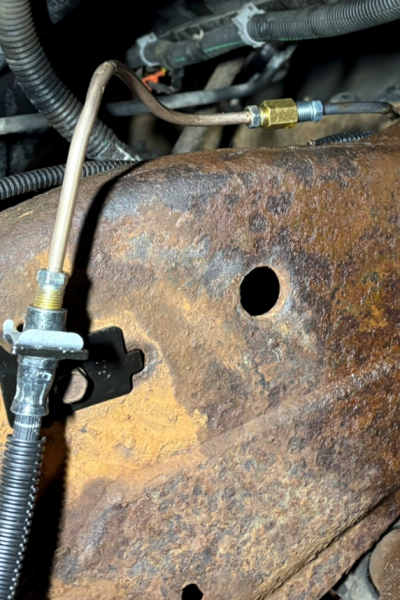
Recommend the OEM brake hoses signifcantly over the aftermarket

1766779641030.png

this is an OEM hose, but the aftermarket i had was a slightly smaller hose, shorter by an inch or 2 which caused ti to pull tightly in turns (2500HD, maybe wouldnt on a 1500) and the bracket was cheap
 

AuroraGirl

Well-Known Member
Joined
Dec 24, 2023
Messages
435
Reaction score
853
Location
Wisconsin
1766779898143.png1766779913074.png1766779941660.png
Scraping Noise From Rear of Vehicle (Replace Parking Brake Shoe Kit and Clean Drum in Hat Rotor) #02-05-26-002A - (01/28/2003)
Scraping Noise From Rear Of Vehicle (Replace Parking Brake Shoe Kit and Clean Drum In Hat Rotor)
2002-2003 Cadillac Escalade, Escalade EXT

1999-2003 Chevrolet Silverado 1500 Series Pickups

2000-2003 Chevrolet Suburban, Tahoe 1500 Series Models

2002-2003 Chevrolet Avalanche 1500 Series Models

1999-2003 GMC Sierra 1500 Series Pickups

2000-2003 GMC Yukon, Yukon XL 1500 Series Models

This bulletin is being revised to add Suburban and Yukon XL models. Please discard Corporate Bulletin Number 02-05-26-002 (Section 05 - Brakes).

Condition
Some customers may comment on a scraping noise from the rear of the vehicle while driving. The noise may be intermittent.

Cause
Condition may due to the parking brake shoe contacting the drum in hat rotor without the parking brake being applied, causing premature wear on the shoe lining.

Correction
Replace the parking brake shoe and install a new designed spring clip retainer. Follow the service procedure below to correct this condition.

Raise and support the vehicle. Refer to Lifting and Jacking the Vehicle in the General Information sub-section of the Service Information (SI Document ID #639546).
Remove the tire and the wheel. Refer to Tire and Wheel Removal and Installation in the Tires and Wheels sub-section of the Service Information (SI Document ID #656965).
Relieve the tension on the park brake cables by loosening the nut at the equalizer.
Mark the relationship of the rotor to the hub.
Remove the brake caliper bracket mounting bolts.

Notice
Support the brake caliper with heavy mechanic's wire, or equivalent, whenever it is separated from it's mount and the hydraulic flexible brake hose is still connected. Failure to support the caliper in this manner will cause the flexible brake hose to bear the weight of the caliper, which may cause damage to the brake hose and in turn may cause a brake fluid leak.


Remove the brake caliper and brake caliper bracket as an assembly and support with heavy mechanic's wire or equivalent. DO NOT disconnect the hydraulic brake flexible hose from the caliper.
Remove the rotor retaining push nuts from the wheel studs (if applicable).

Notice
DO NOT use a hammer to remove the rotor from the hub; it may cause damage to the rotor.


Important
The rotor may not be easily removed from the hub due to a rust build up on the outside edge of the drum and hat portion of the rotor.


Remove the rotor from the hub. If the rotor cannot be removed from the hub by pulling on the rotor, use J 46277 rotor removal tool.

Notice
Place J 46277 between the rotor surfaces in the vent section of the rotor. DO NOT place J 46277 on the back side of the rotor surface, it may damage the rotor surface.


Using removal tool J 46277 on slide hammer J 6125B, remove the rotor by placing removal tool J 46277 in the vent section of the rotor at the twelve, three, six and nine o'clock positions, not necessarily in that order.
Clean the rust ridge from the drum portion of the rotor using a grinding stone and rotor resurfacing kit J 41013.
Remove the spring clip bolt (3) and retainer (2) and discard.


Important
Minimum thickness of the parking brake shoe lining in any given spot is 1.5 mm (0.06 in).


Measure the parking brake shoe thickness in multiple spots. Replace the parking brake shoe if the thickness is less than 1.5 mm (0.06 in). Continue with step 14.
If the parking brake shoe lining is greater than 1.5 mm (0.06 in), continue with step 19.


Rotate the parking brake shoe (1) out from the bottom and pull it out of the adjuster. Discard the shoe.
Remove the park brake shoe assembly from the vehicle by placing one of the open ends of the shoe over the axle flange and rotate the shoe until it has cleared the flange.


Turn the adjustment screw (1) to the fully home position in the notched adjustment nut.
Install the new park brake shoe assembly (1) from the parking brake shoe kit, P/N 88982875, to the vehicle by placing one of the open ends of the shoe over the axle flange and rotating the shoe until it is behind the flange.
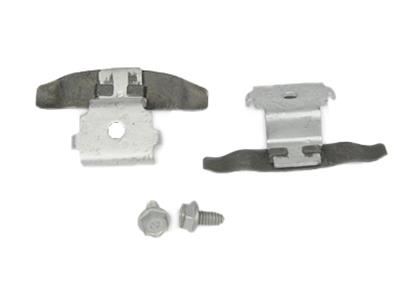
Slide the shoe into the adjuster and position the shoe to the backing plate. Install the retaining spring clip (2) and bolt (3 ) from the parking brake shoe kit, P/N 88982875. If using parking brake service kit 88982875, SKIP STEP 19.
Replace the retaining spring clip (2) and bolt (3) from the parking brake retaining spring clip kit, P/N 88982879. Tighten
Tighten the bolt (3) to 5 N?m (44 lb in).


Set the J 21177-A so that it contacts the inside diameter of the rotor.


Position the J 21177-A over the shoe and the lining at the widest point.


Important
The parking brake adjustment screw threads should not exceed 5 mm (0.2 in) of exposed thread.
The clearance between the park brake shoe and the rotor is 0.6604 mm (0.026 in).

The parking brake adjustment screw threads should not exceed 5 mm (0.2 inch) of exposed thread.

Notice
Whenever the brake rotor has been separated from the wheel bearing flange, clean any rust or foreign material from the mating surface of the rotor and flange with the J 42450 hub cleaning kit. Failure to do this may result in increased lateral runout of the rotor and brake pulsation.


Use the J 42450-A to clean all rust and contaminants from the mating surface of the hub flange.
Use the J 41013 to clean all rust and contaminants from the inside diameter of the hat section of the brake rotor to prevent any foreign material from getting between the brake rotor and the hub flange.
Align the mark on the rotor with the mark on the hub and install the rotor by slowly turning the rotor while pushing the rotor towards the axle.
Install the caliper and the bracket as an assembly to the vehicle.
Perform the following procedure before installing the caliper bracket mounting bolts.
Remove all traces of the original adhesive.
Clean the threads of the bolt with brake parts cleaner, P/N 12346139 (Canadian P/N 10953463), and allow to dry.
Apply threadlocker, GM P/N 12345493 (Canadian P/N 1095348:cool:, or Red LOCTITE? #272, to the threads of the bolt.
Notice
Use the correct fastener in the correct location. Replacement fasteners must be the correct part number for that application. Fasteners requiring replacement or fasteners requiring the use of thread locking compound or sealant are identified in the service procedure. Do not use paints, lubricants, or corrosion inhibitors on fasteners or fastener joint surfaces unless specified. These coatings affect fastener torque and joint clamping force and may damage the fastener. Use the correct tightening sequence and specifications when installing fasteners in order to avoid damage to parts and systems.


Install the caliper bracket mounting bolts. Tighten
Tighten the brake caliper bracket mounting bolts to 175 N?m (129 lb ft).

Repeat this procedure on the other side of the vehicle.
Tighten the nut to the intermediate cable at the equalizer. Tighten
Tighten the nut to 3.5 N?m (31 lb in).

Install the tire and wheel assembly. Refer to Tire and Wheel Removal and Installation in the Tires and Wheels sub-section of the Service Information (SI Document ID #656965).
Lower the vehicle.
Verify that the self adjuster lock-out pin has been removed.
Fully apply and release the park brake pedal three times.
Parts Information
Part Number
Description

88982875
Parking Brake Shoe Kit

889828791766780035672.png
Parking Brake Retainer Spring Clip Kit

12346139 (Canadian P/N 10953463)
Brake Parts Cleaner

12345493 (Canadian P/N 1095348:cool:
Red LOCTITE? #272
 

Latest posts

Members online

Top